Eagle is a genuinely good piece of software. If you are searching for an Eagle alternative, it is probably not because it is bad. It is because Eagle makes a few specific choices, and one of them stopped fitting how you work. This covers alternatives to the Eagle app on Mac and Windows, including an Eagle app free alternative and the best image organizer for designers who mostly save from the web.
This is an honest look at the best alternatives to Eagle, organised by the reason you might be leaving. We make one of them, GetRef, and we say so where it comes up. We also say, more than once, where Eagle is still the right answer.
Why people look for an Eagle alternative
Eagle is a local desktop app for Mac and Windows. Everything follows from that.
- Your library lives on one machine. Syncing it to a second computer means managing the folder yourself, and there is no phone or browser access.
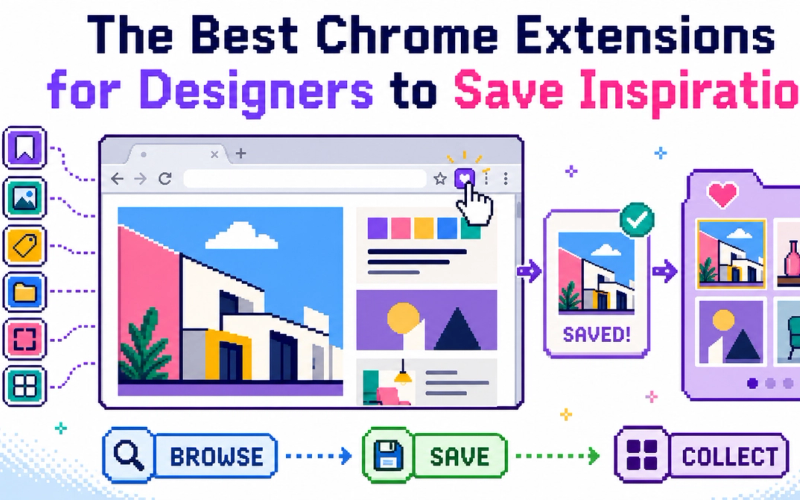
- Saving from the web needs the browser extension talking to a desktop app that has to be open.
- Organising is manual. Folders, tags and smart folders are excellent, but you build them. Eagle does not read your screenshots and tag them for you.
- It is an asset manager first. It is superb at icons, fonts, textures and stock, and less interested in the messy pile of half-remembered web references most product designers actually collect.
If none of those bother you, stop reading and keep using Eagle. If one of them is the reason you are here, the alternatives below are grouped by which one.
If you want to save from anywhere and never file anything
This is the most common reason designers leave Eagle. You see something good in a browser, on your phone, in a Figma file, and you want it kept without opening a desktop app or choosing a folder.
mymind is the best-known answer. Save a link, image or note from anywhere, it is tagged automatically, no folders exist, and you search by describing what you remember. Private, calm, no feed. It is a general memory tool rather than a design tool, so it does not import from Figma and treats a dashboard screenshot the same as a recipe. Subscription only, with a trial rather than a free plan.
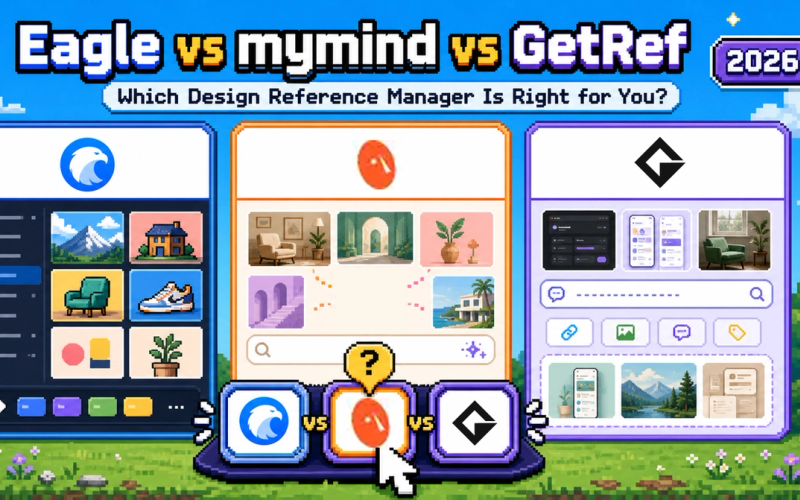
GetRef is the one we make, and it takes the same model and points it at design work. Paste, click or import to save; every reference is read and tagged automatically in design vocabulary: dashboard, pricing, onboarding, dark, editorial. Search by description. It imports directly from Figma files and browser bookmarks, and nothing you save is sent to a third-party AI service. The free plan holds fifty references and three collections with tagging and search included; Pro removes the limits and adds the Chrome extension. We compare it with Eagle and mymind head to head in Eagle vs mymind vs GetRef.
Where these are the wrong choice: neither manages fonts or large local asset collections. If that is your Eagle use case, they are not replacements.
If you want a free local asset manager
Adobe Bridge is the closest free equivalent to Eagle's core job. It is a local file browser and asset manager that handles very large libraries, reads metadata, batch renames, and integrates with the rest of Adobe's tools. It is heavier, slower to open and considerably less pleasant than Eagle, and it does not have Eagle's colour and shape filtering. But it is free, it is local, and it scales.
If you left Eagle over the one-time price, Bridge is the honest answer. If you left over the workflow, Bridge has the same workflow.
If you mostly save links
Raindrop is a bookmark manager with a visual layer. Every save gets a thumbnail, collections can be nested and shared, tags work well, and there are extensions for every browser plus mobile apps. Full-text search of saved pages is available on the paid tier.
It is built around links, not images. Screenshots and files can be added but they are second-class, and there is no automatic understanding of what a page is. For a designer whose references are mostly URLs, it is excellent. For a screenshots pile, it is the wrong tool.
If you want moodboards you can share
Milanote is a canvas for arranging references spatially: images, notes, links and colour swatches on a board you can share with a client or team. It is very good at the presentation end of collecting, when you are shaping a direction rather than filing everything you have ever seen.
It is not a library. Boards do not scale to thousands of items, search is limited, and organisation is by board. Many designers use Milanote for the project in front of them and a separate library for the long-term collection those boards draw from.
If collecting is a practice, not a utility
Are.na is the thoughtful one. Channels instead of folders, blocks that can live in several channels at once, and a community that cares about ideas rather than engagement. There is no algorithm and no feed. It rewards slow, deliberate collecting and is widely used for research and teaching.
Search is basic and it does not read your images, so it is not the tool for "find that pricing page, now". If you are also considering Pinterest-style tools, our Pinterest alternatives for designers covers Are.na alongside Savee and Cosmos.
When Eagle is still the right choice
We would be doing you a disservice by pretending otherwise. Eagle remains the best tool we know of when:
- You manage thousands of local images, fonts, textures or stock assets.
- You need instant filtering by colour, shape, format or dimensions.
- You want font management built into the same library.
- You work from one machine and want everything local and offline.
- You prefer a one-time purchase to a subscription.
If most of that list is you, the alternatives above will feel like a step backwards. The right move is often to keep Eagle for production assets and add a lightweight reference tool for the web screenshots it was never designed for. Asset management and reference management are different jobs, and the cleanest setups treat them that way.
How to switch without losing your library
- Export from Eagle. Your files are already ordinary files in a folder on disk; tags live in Eagle's metadata, so note which ones matter.
- Import the whole folder into the new tool in one go. Do not sort first.
- Let automatic tagging run, then delete junk from inside the tool where you can see it in context.
- Set up saving from the browser so new references never touch the desktop.
- Give it a fortnight, then try to find three specific things. If it is faster than Eagle was for you, it worked.
For the system behind all of this, from capture to tags to pruning, see how to save design references. And if the thing you are actually trying to do right now is dig one particular screenshot out of an old pile, start with how to find a screenshot you can only half remember.
Common questions
- What is the best Eagle alternative?
- It depends on why you are leaving. For save-from-anywhere with automatic tagging, GetRef or mymind. For a free local asset manager, Adobe Bridge. For visual bookmarks, Raindrop. For collaborative moodboards, Milanote. For slow, considered collecting, Are.na. If you need fast filtering of thousands of local images and fonts, Eagle is still hard to beat.
- Is there a free alternative to Eagle?
- Adobe Bridge is free and handles large local libraries well, though it is heavier and less pleasant than Eagle. GetRef has a permanent free plan of fifty references with automatic tagging and search. Are.na and Raindrop both have free tiers.
- Does Eagle work in the browser or on mobile?
- Eagle is a desktop application for Mac and Windows. Your library lives on that machine unless you sync the folder yourself. If you need to save and search from any device, a cloud-based tool such as GetRef or mymind is the better fit.
- What is the difference between an asset manager and a reference manager?
- An asset manager like Eagle or Bridge organises files you own and use in production: icons, fonts, textures, stock. A reference manager like GetRef or mymind organises things you saw and want to remember: screenshots, links, examples. Many designers need one of each, not one tool for both.