If you are searching for how to save design references, you already know the problem. The screenshot is on the desktop. The link is in a message you sent yourself. The colour palette is in a Figma file called "inspo 3". You saved every one of those things because it was good, and now that you need one of them, it might as well not exist. This is the system behind any good design inspiration organizer or design reference manager, and it applies however you organize design references today.
This guide is the best way to save design references we know of, built from years of losing them. It is not about one app. It is about a handful of decisions you make once, after which saving design inspiration stops being a chore and finding it stops being luck.
Why most designers cannot find what they saved
Almost every designer has a design reference library. Almost none of them has a searchable one. The difference is not effort. It is that the tools most people use to save design inspiration were built for something else.
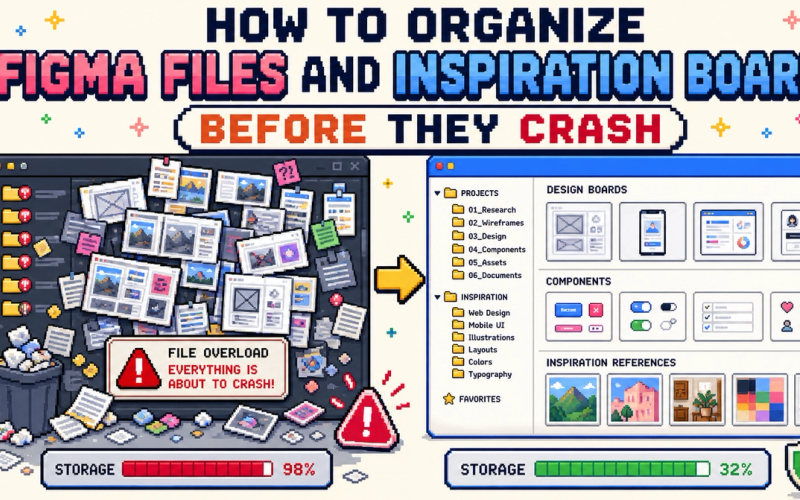
Pinterest was built to show you more pins. Browser bookmarks were built to return to a page, not to browse a collection. A screenshots folder was built by your operating system with no idea what a screenshot is. Figma files were built for designing, and inspiration boards inside them grow until they crash.
Each tool is fine at its own job. None of them is a reference manager. So designers end up with five partial libraries and no way to search across them, which is functionally the same as having none.
How to save design references, rule one: everything in one place
The single biggest improvement you can make to how you save design references is to stop spreading them out. One home. Everything goes there.
That home has to accept every type of reference you actually collect: screenshots, images, links, colour palettes, text snippets, and increasingly AI prompts. The moment one type does not fit, you will start a second pile for it, and the second pile is where things go to be forgotten.
It also has to be reachable from everywhere you work. If saving from the browser needs a different tool than saving from Figma, you are back to two piles.
Rule two: capture must take two seconds
Here is a test for any design inspiration organizer: could you save something mid-task, without stopping to think? You saw a good pricing page while doing something else. Can you keep it and get back to work in the time it takes to read this sentence?
If saving means choosing a folder, writing a filename and picking tags, the honest answer is no. You will do it properly for a week and then stop, and it will not be for lack of discipline. The reference arrived while you were busy. Anything that makes it expensive to keep will lose to the task you were actually doing.
The fix is to move the effort off the moment of capture. Paste a screenshot and it is saved. Click an extension and the page is saved. Drop a link and it is saved. Tagging, naming and sorting happen afterwards, and ideally happen automatically. This is the principle GetRef is built around, but it applies to any tool you choose.
Rule three: tags, not folders
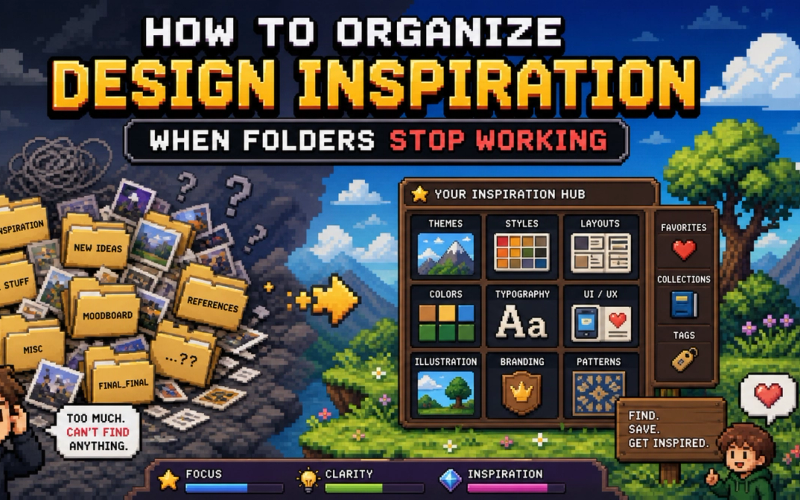
A design reference is never one thing. A dark fintech dashboard is a dashboard, it is fintech, it is dark, and you probably saved it for the typography. A folder makes you pick one of those four. Tags let it be all of them at once, and let you find it by any of them later.
The mistake people make with tags is inventing too many. Keep the list short and closed: around forty tags you actually reuse beats four hundred you made up once and never typed again. A good set answers four questions about every reference:
- What it is: landing page, dashboard, pricing, onboarding, empty state.
- What field: fintech, saas, health, ecommerce, devtool.
- How it looks: dark, minimal, editorial, brutalist, playful.
- Why you kept it: layout, typography, motion, colour, microcopy.
That last group is the one everyone skips, and it is the one that pays. "Why you kept it" is the thing you will remember in three months. We go deeper on this in how to organize design inspiration when folders stop working.
Rule four: write one sentence about why
Filenames tell you nothing. "Screenshot 2026-03-14 at 11.42.08.png" records when you pressed a key, not what you were looking at or why it mattered. The most valuable thing you can attach to a saved design reference is a single line: why did I save this?
"Pricing table with the plan toggle done right." "That gradient on the hero." "How they handle the empty state on first login." Three months later, that sentence is exactly what you will type into search, and it is the thing no filename or auto-tag can supply for you.
Rule five: screenshot the thing and keep the link
Links rot. Sites redesign, pages move, startups shut down. A bookmark to a great landing page from two years ago is very often a bookmark to a 404. Save a screenshot of what you actually saw, so the reference survives the source.
Keep the link next to it. You will want it for credit, for context, and for the days the site is still up and you want to see how it behaves. A good design reference library captures both from a single save, so you never have to choose.
Rule six: import what you already have
An empty library gets abandoned. A library with three hundred things in it on day one is useful immediately, and being useful is what makes you keep using it.
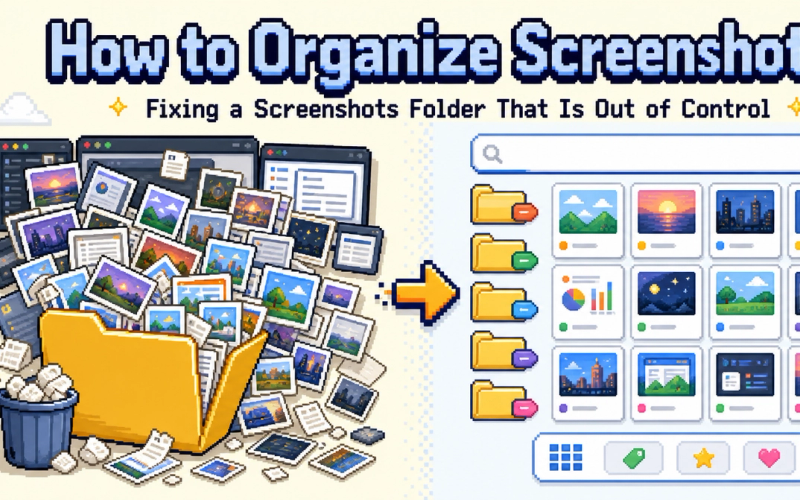
Before you save anything new, bulk import everything you already have: the screenshots folder, browser bookmarks, the Figma inspiration files. Do not sort first. Sorting a backlog is the task nobody starts. Import all of it, let automatic tagging do the first pass, and delete junk from inside the library as it surfaces. If your screenshots folder is the main offender, here is how to get it under control without renaming a single file.
Rule seven: make it searchable by description
Everything above leads here. The point of saving design references is finding them again, and the way you will look for one is by describing it: "dark dashboard with a big number on the left", "pricing page with the annual toggle". A library that can only be searched by filename or by tags you typed will fail that test.
The tools that pass it read your references when you save them. Text recognition turns the words on a screenshot into search terms. Automatic tagging records what kind of thing it is and how it looks. Your one-line note records why. Now your description is the search, and the library has already written it down. We cover the mechanics in how to find a screenshot you can only half remember.
A setup you can do this afternoon
- Pick one home for everything. Not two.
- Import the screenshots folder, bookmarks and Figma boards in one go.
- Write your forty tags in a note. Do not add any for a month.
- Save from wherever you are, with one paste or one click.
- Add one line saying why, every time.
- Prune once a quarter. Anything you would not show a client, delete.
If you are choosing a tool to do this in, we compared the main options honestly in Eagle vs mymind vs GetRef, including where each is the wrong choice.
The measure of success is not how many design references you have saved. It is whether, three weeks from now, you can get back the one you need in under ten seconds.
Common questions
- How to save design references so you can find them again?
- Keep one library instead of several, use tags instead of folders, and add a one-line note to each save saying why you kept it. Capture should take two seconds or less. If saving is slow you will stop doing it within a fortnight, and the best system is the one you actually use.
- Should I save design references as screenshots or links?
- Both, in the same place. Links rot when sites redesign or shut down, so a screenshot preserves what you actually saw. Keep the link alongside it for context and credit. A good design reference library captures both from a single save.
- How do designers organize design inspiration?
- The designers who can find things again tend to use a single searchable library with automatic tagging, rather than folders or Pinterest boards. Folders force a reference into one category when it belongs in several, and Pinterest is built for discovery rather than retrieval.
- How many design references should I keep?
- As many as you can find again. Volume is not the problem; retrieval is. If you can get a specific reference back in under ten seconds, your library is the right size. If you cannot, prune rather than adding more.