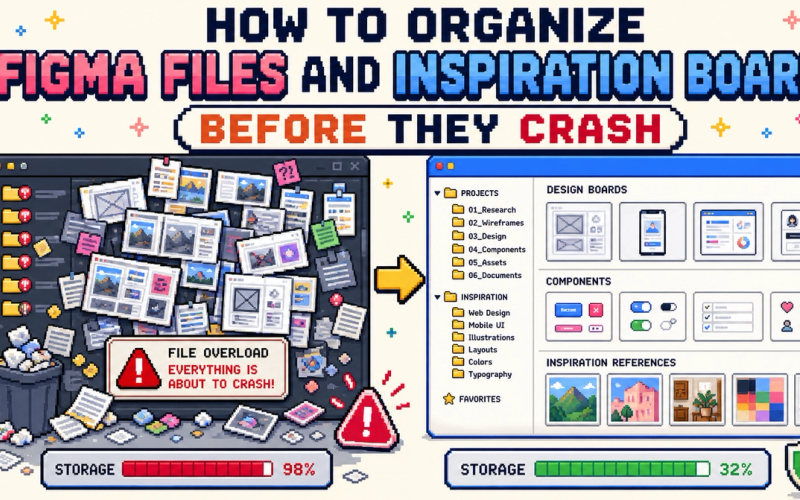
Open your screenshots folder and scroll. Rows of identical thumbnails, every one named "Screenshot 2026-03-14 at 11.42.08.png" or a Windows equivalent. Somewhere in there is the pricing page you loved, the onboarding flow you wanted to borrow, the error state that was done perfectly. You could not point to any of them. This is how to organize screenshots without renaming a single file, using a screenshot organizer that reads them for you.
If you are looking up how to organize screenshots, the good news is that this is not a discipline problem. The screenshots folder fails every designer at roughly the same size, for the same reason, and the fix does not involve renaming a single file.
Why the screenshots folder breaks at around two hundred files
Up to a few dozen screenshots, you can scroll and recognise thumbnails. Past that, recognition stops working. Every thumbnail is a rectangle of interface. Every filename says when and never what. And the one thing you actually remember about the screenshot, that it was "the dark one with the big serif headline", is recorded nowhere.
The folder has exactly one piece of metadata: the timestamp. You do not remember timestamps. So the folder is, in effect, unindexed. It is not badly organised. It is not organised at all, and no amount of willpower changes what the operating system wrote down.
Why renaming screenshots does not scale
The obvious fix is to rename files as you go. Everyone tries it. Nobody keeps it up, and the reason is timing. Renaming happens at the worst possible moment: mid-task, when you took the screenshot precisely because you were busy doing something else. A naming convention that costs ten seconds per file is a convention that dies within a fortnight.
Subfolders fail the same way, with an extra problem. "Dashboards" versus "dark mode" versus "fintech" forces a decision the screenshot does not want to make. It belongs in all three. Whichever you pick, you will look in one of the other two next time. We cover why tags beat folders in how to save design references.
How to organize screenshots so they are actually findable
The way out is to stop describing screenshots yourself and let software read them.
A screenshot of a pricing page contains the words "Free", "Pro" and "per month". A screenshot organizer that runs text recognition on your images turns those words into search terms without you typing anything. Suddenly a search for "pricing" finds every pricing page you ever captured, including the ones you forgot you took.
Automatic tagging does the same for the visual side. Dark or light, dashboard or landing page, dense or minimal. You did not tag it, and it is tagged. Add a one-line note about why you kept it and you have three ways to find any screenshot, none of which required a filename.
This is how GetRef works: paste a screenshot, it is read and tagged on the spot, and you search by what you remember. The principle holds for any tool you pick. If it cannot see inside the image, the folder problem comes back within a month.
Too many screenshots? Clear the backlog without sorting it
Do not sort before you import. Sorting a backlog of four hundred screenshots in Finder is the task you will never start, because every file looks the same and every decision takes a minute.
Import the entire folder in one go. Let text recognition and tagging run over all of it. Then delete from inside the tool as junk surfaces, where you can see the screenshot at full size with its tags next to it. Deleting a bad reference in context takes a second. Deciding whether to keep a thumbnail in Finder takes a minute. That difference is the whole reason backlogs never get cleared.
Organizing screenshots on Mac: two settings worth changing
If you are on a Mac, two small changes stop the pile from re-forming.
First, move screenshots off the desktop. Open the Screenshot app (Shift, Command, 5), choose Options, and pick a folder under Save To. The desktop is where screenshots go to be forgotten; a dedicated folder is at least a single place to import from.
Second, use the floating thumbnail. When it appears in the corner after a capture, drag it straight into your reference library instead of letting it land on disk at all. The screenshot never touches the folder, so the folder never grows.
Windows users get the same effect by changing the Snipping Tool's save location, or by pasting straight from the clipboard into the library rather than saving first.
Keep the screenshots folder from coming back
- Save from the browser directly, so screenshots never land on disk.
- Add one line saying why you kept it. Not a name. A reason.
- Prune once a quarter. Anything you would not show a client, delete.
- Never create a second pile. If something does not fit, the tool is wrong, not the thing.
If you are trying to dig one specific screenshot out of the pile right now, here is how to find a screenshot you can only half remember, including what to try on your Mac before you move anything.
The screenshots folder does not need to be organised. It needs to be searchable. Those are different problems, and only one of them is worth your time.
Common questions
- How to organize screenshots when there are hundreds of them?
- Do not rename them one by one. Move the whole folder into a tool that reads the text inside each image and tags it automatically, then search by what you remember rather than by filename. Delete junk from inside the tool, where you can see it in context.
- How do I organize screenshots on a Mac?
- Change the default save location so screenshots stop landing on the desktop, then import the existing folder into a screenshot organizer that does text recognition. Finder folders and renaming both stop working at around two hundred files.
- Why are my screenshots all named with dates?
- macOS and Windows name screenshots by the moment they were taken because the timestamp is the only thing the system knows about them. It records nothing about the content, which is why the folder becomes unsearchable as it grows.
- Should I delete old screenshots?
- Delete anything you would not show a client. Keep the rest only if you can search it. An unsearchable archive is the same as a deleted one, just larger and slower.