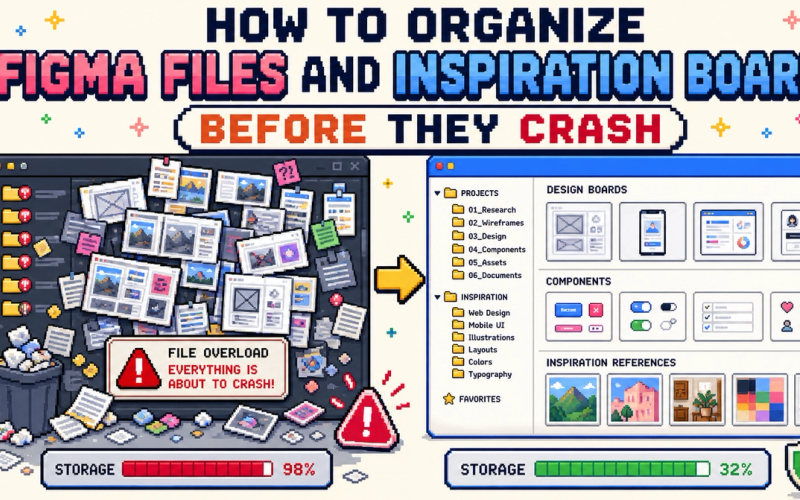
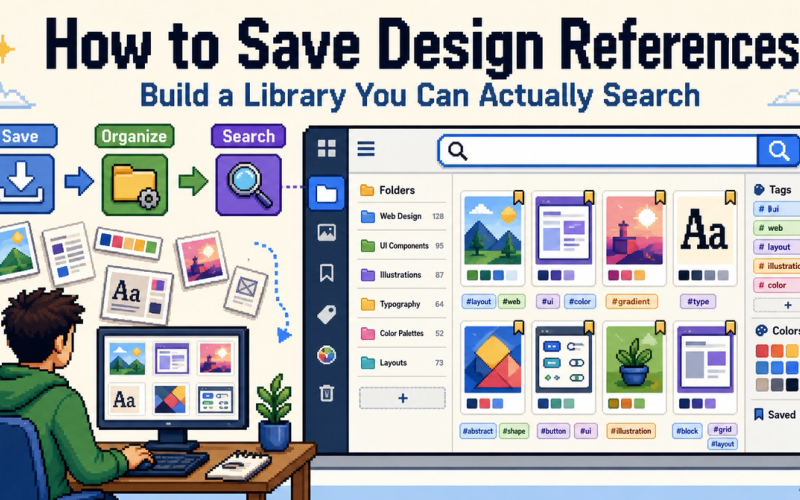
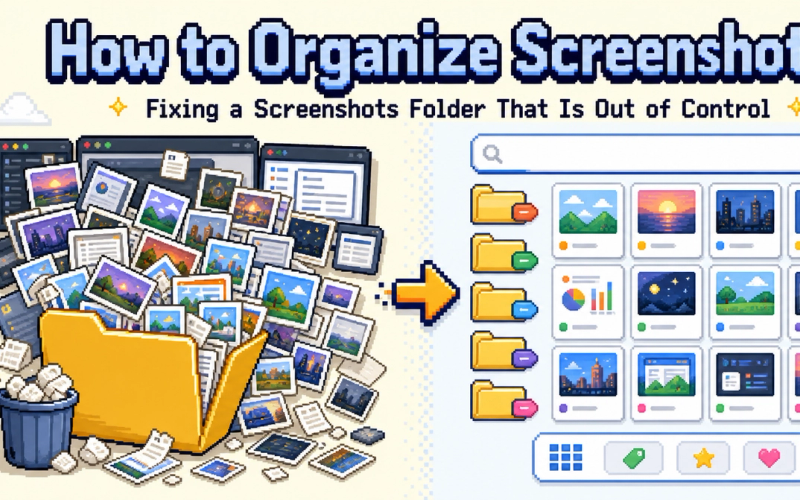
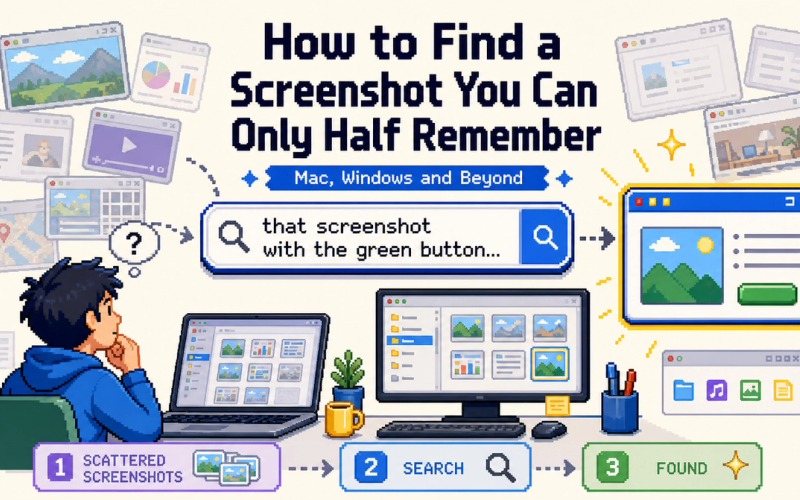
Every designer has the folder. It's called Inspiration, or refs, or screenshots, and it holds four hundred images with names like Screenshot 2026-03-14 at 11.42.08.png. You saved every one of them because it was good. You have not opened it in eight months. This is how to organize design inspiration so it stays findable. Any design inspiration organizer or design reference library has to solve the same problem, and the way you tag design references decides whether it does.
The folder isn't the problem. Saving is easy. You already do it. The problem is retrieval: three weeks later you need "that pricing page with the dark gradient and the weirdly good comparison table," and there is no way to ask your computer that question.
Here's a system that survives scale, in the order the problems actually arrive.
Why your inspiration folder stops working
Folders force a decision at the exact moment you have the least patience for it. You've just seen something good, you're mid-task, and to save it properly you must answer: is this layout, or typography, or fintech, or dark mode? It's all four. So it goes in refs/ and the decision is deferred forever.
Three failures compound:
One thing, one place. A dashboard with beautiful data-viz and a great empty state belongs in two folders and lives in neither. Every taxonomy built on folders eventually needs duplicates, and duplicates rot.
Filenames carry nothing. Screenshot 2026-03-14.png records when you pressed a key, not what you were looking at or why you cared. The one piece of information worth keeping (why did I save this) is the piece nothing captures.
Visual memory doesn't index alphabetically. You don't remember the file. You remember a feeling: it was dark, it was confident, there was a lot of whitespace, the numbers were huge. None of that is searchable text.
Decide what you're building first
Before tooling, be honest about which of these you actually need. They pull in opposite directions:
| You want | Then optimise for | Good fit |
|---|---|---|
| A moodboard for one project | Visual arrangement, side-by-side | Milanote, PureRef, Figma |
| A permanent personal library | Search and recall | A reference manager |
| Team-shared brand assets | Permissions and versioning | A DAM like Frontify |
| Casual browsing | Discovery, not retrieval | Pinterest, Savee, Dribbble |
Most people mix these and then blame the tool. A moodboard is meant to be looked at all at once and thrown away when the project ships. A library is meant to be queried, and it lives for years. If you're trying to make Pinterest boards do library work, that's the mismatch: Pinterest is designed to show you more things, not to give you back the specific thing you saved.
A tagging system that survives 500 references
Tags fix the "one thing, one place" problem, because a reference can carry six of them. But untended tags become their own mess: dark, darkmode, dark-mode, and dark_ui all describing the same twelve images.
Keep a tag dictionary (a short, closed list you actually reuse) and build it on four axes:
- What it is,
landing-page,dashboard,pricing,onboarding,email - What field it's from,
fintech,saas,health,devtool,agency - What it looks like,
dark,brutalist,editorial,minimal,gradient - Why you kept it,
layout,type,motion,microcopy,illustration
Four to six tags per save, drawn from a list of maybe forty. The rule that matters: if a tag has one item in it, it isn't a tag. It's a note. Fold it into an existing one or write it in the description field.
That last axis is the one everyone skips and the one that pays. layout versus microcopy is the difference between "show me nice pages" and "show me pages I saved because the words were good."
How to find a reference you can barely remember
This is where every filing system meets its limit, because the query in your head isn't a keyword. It's "the one with the moody dark blue and the big serif headline, some kind of banking app maybe?"
Three things make that answerable:
Save the context, not just the image. One sentence at save time ("great use of a single accent colour on an otherwise grey dashboard") is worth more than any folder. You're writing down the reason while you still remember it.
Make the text inside images searchable. A screenshot of a pricing page contains the words "Free", "Pro", "per month". If your tool reads text out of images (OCR), those become search terms without you typing anything. This is the single biggest upgrade available to a screenshot library, and it's why Screenshot 2026-03-14.png is not as hopeless as it looks.
Search by description, not filename. Newer tools accept "dark fintech dashboard" and return things that match the sense of the phrase, even when none of those exact words appear anywhere. That's the query your brain already produces.
The part that actually decides whether this works
None of this survives if saving takes more than a couple of seconds.
Any system that asks you to name a file, choose a folder, and write tags at the moment of capture will be abandoned inside a fortnight: not because you're undisciplined, but because you're mid-task and the cost is real. Shift the work: capture instantly, organise automatically, refine only when you're actually browsing.
Concretely, that means the save action is one keystroke or one click from wherever you are, tags are suggested rather than demanded, and you're allowed to fix them later, or never.
How to organize design inspiration: a starting point you can set up today
- Pick one home. One library, not four. Scattered is worse than imperfect.
- Write your forty tags in a note before you import anything. Ten minutes now, and you'll reuse it for years.
- Import what you already have. Your existing
refsfolder and your browser bookmarks are years of taste sitting in the dark. Bring them in before you save anything new, a library with 300 things in it is useful immediately; an empty one gets abandoned. - Add one sentence per save. Just the reason.
- Prune once a quarter. Anything you'd never show a client, delete. A smaller library you trust beats a bigger one you avoid.
The measure of success isn't how much you've saved. It's whether, three weeks from now, you can get back the one thing you need in under ten seconds.
Common questions
- How to organize design inspiration so you can find it again?
- One library rather than several, tags instead of folders, and a one-line note saying why you saved each thing. Folders force you to file something under a single heading when most references belong under four, so a tagged library with a short reusable tag list scales where a folder tree doesn't.
- Should I use folders or tags for design references?
- Tags. A reference can carry several at once, which matches reality: a dark fintech dashboard is a dashboard, it's fintech, it's dark, and you may have saved it for the layout. Folders make you pick one and lose the rest. Keep the tag list short and closed (around forty tags you actually reuse) or it becomes its own mess.
- Is Pinterest good for saving design inspiration?
- It is good for finding things and poor for getting them back. Pinterest is built to show you more content, not to return the specific reference you saved eight months ago. It works as a discovery feed alongside a proper library; it does not work as the library.
- How do I find a screenshot when I can't remember the filename?
- Filenames are the wrong handle: nobody remembers Screenshot 2026-03-14 at 11.42.08.png. Use a tool that reads the text inside your images so the words on a pricing page become searchable, and that accepts a description like "dark fintech dashboard" rather than exact keywords.
- How many design references is too many?
- There's no ceiling if retrieval works, and about two hundred if it doesn't. The number that matters isn't how much you've saved but whether you can get one specific thing back in under ten seconds. If you can't, prune rather than keep adding.